Research Article | | Peer-Reviewed

Level of Technical Efficiency in Maize Production in Uasin Gishu and Transzoia Counties in Kenya

Received: 6 August 2025     Accepted: 21 August 2025     Published: 15 October 2026
Views:       Downloads:
Abstract

Maize is a vital staple crop in Kenya, essential to both food security and rural livelihoods, especially in key producing regions like Uasin Gishu and Transzoia Counties. Despite their potential, maize yields in these counties remain significantly below optimum levels-averaging 400,000 and 600,000 metric tons respectively, against potentials of 900,000 and 1,000,000 metric tons. This discrepancy signals inefficiencies in resource use among smallholder farmers. To investigate this issue, the study focused on assessing the level of technical efficiency in maize production and identifying the factors contributing to inefficiency. Rooted in the Stochastic Frontier Analysis (SFA) framework and guided by the Cobb-Douglas production function, the study adopted a descriptive survey design. A sample of 274 farmers was selected from a target population of 16,300 using Cochran’s 1963 formula and stratified random sampling. Primary data were collected through structured, self-administered questionnaires. The results revealed that technical efficiency among farmers ranged from 0.75 to 0.91, with significant inefficiency driven by factors such as education level, farm size, and access to extension services. These findings indicate that productivity could be improved by up to 25% through more efficient resource utilization. The study recommends targeted policy interventions, including farmer training, expanded extension services, and improved access to modern inputs to enhance maize productivity and food security in the region.

Published in International Journal of Agricultural Economics (Volume 11, Issue 5)
DOI 10.11648/j.ijae.20261105.13
Page(s) 178-185
Creative Commons

This is an Open Access article, distributed under the terms of the Creative Commons Attribution 4.0 International License (http://creativecommons.org/licenses/by/4.0/), which permits unrestricted use, distribution and reproduction in any medium or format, provided the original work is properly cited.

Copyright

Copyright © The Author(s), 2026. Published by Science Publishing Group

Keywords

Technical Efficiency, Maize Production, Resource Utilization, Stochastic Frontier Analysis, Smallholder Farmers, Kenya

1. Introduction
Maize is a cornerstone crop globally, playing a pivotal role in food security, particularly across Sub-Saharan Africa. In 2022, worldwide maize production surpassed 1.2 billion metric tons, with the United States, China, and Brazil leading the charge . Africa, however, contributes only around 7% of this total, with Kenya standing out as a key producer in the region . Despite its vital importance, maize farming is far from straightforward. Farmers face numerous hurdles, including the impacts of climate change, pest outbreaks, and unpredictable market prices—challenges that especially affect smallholders . On top of that, limited access to modern farming technologies stifles productivity in major maize-growing areas like Uasin Gishu and Transzoia Counties .
In Kenya, maize farming is central to both food security and the livelihoods of rural communities, with smallholder farmers responsible for around 80% of the country’s maize production . However, the average maize yield remains far below its potential. Nationally, farmers are only able to harvest between 6.5 to 8.1 bags per acre, while the land could potentially yield 38 bags per acre . This productivity gap is particularly noticeable in Uasin Gishu and Transzoia Counties, where output remains well under the attainable levels . Uasin Gishu, for example, produces roughly 400,000 metric tons annually, though it could reach 900,000 metric tons Transzoia, similarly, is stuck at around 600,000 metric tons, well short of its potential of 1,000,000 metric tons .
The level of technical efficiency in maize farming refers to maximizing output from the resources available. In Uasin Gishu County, the level of technical efficiency is estimated at 80%, which suggests there’s room for a 20% boost in production if resources were utilized more effectively . On the other hand, Transzoia County has a lower efficiency rate of 75%, indicating that output could rise by 25% with better resource management . Several factors contribute to these inefficiencies, including poor access to modern farming inputs, the ongoing effects of climate change, pest invasions, and soaring input costs, such as the rising price of fertilizers . Land fragmentation and lack of adequate storage infrastructure also hold back production .
Improving the level of technical efficiency is critical to increasing maize yields and tackling food security issues in Kenya. By optimizing resource use, productivity can be significantly raised without the need for additional financial investment or harming the environment . Although the government has rolled out initiatives like input subsidies and agricultural extension services, inefficiencies continue to plague smallholder farmers . Focused efforts to introduce modern farming technologies and improve access to necessary inputs could go a long way in closing the productivity gap . This study aims to evaluate the the level of technical efficiency of maize farming in Uasin Gishu and Transzoia Counties, offering practical recommendations to boost productivity and support sustainable agricultural growth in Kenya.
1.1. Statement of the Problem
The success of maize farming in Kenya depends on efficiently managing resources to maximize yields without raising costs or harming the environment . However, in Uasin Gishu and Transzoia Counties, maize farming has not reached this ideal state. Despite the capacity to significantly increase yields, farmers in these regions have not fully exploited their available resources. In Uasin Gishu, for example, over 100,000 hectares are devoted to maize cultivation, yet only about 400,000 metric tons are produced annually, while the potential production could reach 900,000 metric tons . In Transzoia, 114,320 hectares of maize farming yield approximately 600,000 metric tons annually, falling short of its potential of 900,000 metric tons . These inefficiencies limit the counties' contributions to national food security and economic stability, with negative consequences for rural livelihoods. This inefficiency is due to factors like rising input costs, inadequate storage, and erratic weather patterns, alongside post-harvest losses ranging from 8% to 40% . In Uasin Gishu, the level of technical efficiency is 80%, suggesting a 20% increase in output is possible . Transzoia’s the level of technical efficiency is 75%, indicating a 25% potential gain . Despite various interventions, such as input subsidies and extension services, which primarily focus on improving access to agricultural inputs, the efficiency of resource use among smallholder farmers has not seen the expected improvements. This gap in research has left a critical question unresolved: how can smallholder farmers in these counties increase their productivity with the resources currently available to them? Without targeted interventions to enhance the efficient use of resources, the problem of inefficiency is likely to persist, threatening food security and the economic stability of farming communities in the region. This study sought to address this gap by analyzing the factors influencing the the level of technical efficiency of maize production in Uasin Gishu and Transzoia Counties.
1.2. Objective of the Study
To determine the level of the level of technical efficiency in maize production in Uasin Gishu and Transzoia Counties in Kenya.
1.3. Research Question
What is the level of the level of technical efficiency in maize production in Uasin Gishu and Transzoia Counties in Kenya?
1.4. Significance of Study
The study contributes explicitly to understanding the factors influencing the level of technical efficiency in maize production, providing insights to policymakers for informed decision-making and agricultural planning. It empowers farmers with knowledge to enhance productivity and optimize resource use, while offering investors valuable information on improving agricultural practices. Additionally, the study aids agricultural extension officers in designing effective training and support programs for smallholder farmers. Ultimately, it promotes food security, economic stability, and sustainable agricultural growth in the region.
2. Theoritical Framework
The Stochastic Frontier Analysis (SFA) model is widely used to estimate the level of technical efficiency while accounting for random errors and inefficiency effects. This model assumes that deviations from the production frontier result from both random shocks and inefficiency. The general form of the SFA model is: Ln(y) = F(x; β) + v1 − u1= 1, 2,.. N
In this equation the v1-are assumed to be independent and identically distributed random errors following a normal distribution with zero mean and variance (σv2). Unlike deterministic models, stochastic frontiers enable the estimation of standard errors and hypothesis testing, which improves reliability by addressing statistical noise and measurement errors . The method allows researchers to determine whether deviations from the frontier output result from firm-specific factors or external random factors, enhancing the accuracy of efficiency assessments.
The stochastic frontier approach is advantageous for estimating farm-specific technical efficiencies by comparing actual output to a hypothetical maximum output if inefficiencies (ui) were absent. Despite its usefulness, the method requires specifying a functional form, such as Cobb-Douglas or Translog, and making distributional assumptions about inefficiency, which may not always be justified . While Cobb-Douglas and Translog functions are popular choices, both have advantages and limitations . The stochastic frontier model is particularly suited to agricultural production analysis, where external shocks such as weather, pests, and inaccurate data are prevalent . In this study, a Cobb-Douglas stochastic production function was applied, using the Frontier 4.1 software developed by Coelli to analyze the data, as this approach effectively separates inefficiencies from random errors .
2.1. The Conceptual Framework
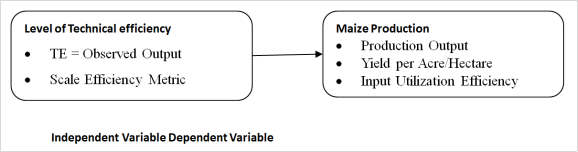
The study was guided by a conceptual framework (Figure 1), with level of technical efficiency as the independent variable and maize production as the dependent variable.
Figure 1. Conceptual Framework.
2.2. Empirical Review: The Level of Technical Efficiency in Maize Production
In a global context, a study by , employed the Stochastic Frontier Analysis (SFA) model to assess the level of technical efficiency of maize production across several developed countries. The study analyzed data from 1,200 maize farmers in regions including Latin America, Africa, and Asia. Using farm-level data on inputs such as land, labor, and fertilizers, the study found significant inefficiencies in resource use, with many farmers operating below their potential due to limited access to modern inputs and climate-related challenges. The results highlighted that improving access to technology and agricultural practices could raise the level of technical efficiency by 30%. Although the study provided insights into global maize farming efficiency, it did not focus on specific countries or regions, including Kenya, which necessitated localized research for a deeper understanding of the constraints and opportunities in areas like Uasin Gishu and Transzoia counties.
A study was conducted on the level of technical efficiency of smallholder maize farmers in Uganda, focusing on resource use efficiency and productivity . They used a stochastic frontier model to analyze data from 500 smallholder farmers and found that the average the level of technical efficiency was around 75%, with major inefficiencies stemming from poor soil management, inadequate access to inputs, and limited extension services. The study indicated that larger farm sizes and better access to credit and extension services were associated with higher levels of efficiency. While the study provided useful insights into the inefficiencies faced by maize farmers in Uganda, it did not address specific issues in Kenya, particularly in Uasin Gishu and Transzoia counties, which are major maize-producing regions. This gap pointed to the need for research that directly investigates the the level of technical efficiency of maize production in Kenya’s key agricultural zones.
A study focused on the level of technical efficiency of smallholder maize farmers in Uasin Gishu County, Kenya, using the Stochastic Frontier Analysis (SFA) model . The study surveyed 150 maize farmers and found that the mean the level of technical efficiency was 80%, suggesting that there was a 20% potential increase in maize yields if farmers utilized their resources more effectively. The study identified several factors contributing to inefficiency, including high input costs, limited access to modern inputs like fertilizers and seeds, and poor soil management practices. The research also pointed out that education, extension services, and farm size positively influenced efficiency. However, it did not consider the broader economic and infrastructural challenges specific to Transzoia County, which this study aimed to address by including both counties in the analysis of maize production efficiency.
A study examined the level of technical efficiency of smallholder maize farmers in Transzoia County, Kenya, using a two-stage nonparametric approach . The study sampled 200 smallholder farmers and found that the average the level of technical efficiency was 78%, with inefficiencies attributed to factors such as limited access to agricultural credit, inadequate extension services, and fluctuating market prices. The study also revealed that factors like education, family size, and access to water significantly influenced the farmers' ability to optimize resources. While the research provided valuable insights into the inefficiency of maize farming in Transzoia, it did not provide a comparative analysis with Uasin Gishu, where similar issues might manifest differently due to varying regional challenges. This gap highlighted the need for a comparative study of the two counties to understand how regional factors affect maize production efficiency.
A study explored the level of technical efficiency in crop production across several Kenyan regions, including Mwea, West Kano, Ahero, and Bunyala, using meta-frontier analysis . The study included data from 1,000 farmers across the regions, with a focus on evaluating the influence of agricultural technology adoption and climate variability on efficiency. The findings revealed that regions with better access to irrigation and improved agricultural technology had higher technical efficiency. The study found that the level of technical efficiency varied significantly across regions, with Mwea showing the highest efficiency. However, it did not focus on maize farming in key regions like Uasin Gishu and Transzoia counties, where the majority of Kenya’s maize is produced. This omission underlined the need for specific research on maize production efficiency in these crucial areas to provide region-specific insights for policy and practice.
3. Research Methodology
This study employed a survey research design to assess the level of technical efficiency in maize production among smallholder farmers in Uasin Gishu and Transzoia counties, Kenya . The target population consisted of 16,300 small-scale maize farmers, with a sample size of 274 determined using Cochran's (1963) formula. Stratified random sampling was used to select farmers from different wards, ensuring a representative sample . Data was collected through a self-administered structured questionnaire using a 5-point Likert scale adapted from prior studies . Data analysis involved both descriptive statistics and econometric models, including the stochastic frontier approach to estimate efficiency levels and identify factors affecting inefficiency. The model employed was the Cobb-Douglas production function, with the inefficiency term estimated using the equation U1=Zδ+w1, where Z represents exogenous variables .
4. Data Analysis, Results and Discussion
This section presents an analysis of the level of the level of technical efficiency using descriptive statistics, inferential statistics, and Stochastic Frontier Analysis (SFA) based on the survey data.
4.1. Analysis of the Level of Technical Efficiency Using Descriptive Statistics
In this subsection, we will summarize the level of technical efficiency variables using descriptive statistics, including mean, standard deviation, and frequency distributions.
Table 1. Analysis of the level of technical efficiency Using Descriptive Statistics.

The level of technical efficiency Variable

Mean

Standard Deviation

Minimum

Maximum

Efficiency of Input Use

3.45

0.79

1

5

Yield Potential

3.85

0.72

1

5

Resource Utilization Efficiency

3.60

0.85

1

5

Overall Technical Efficiency

3.60

0.75

1

5

Source: Field Data, 2025
Based on Table 1, the mean scores for the level of technical efficiency variables, including efficiency of input use (3.45), yield potential (3.85), and resource utilization efficiency (3.60), are all above 3, indicating that farmers generally perceive themselves as efficient in these areas. This suggests that farmers believe they are utilizing inputs effectively, achieving high yield potential, and efficiently managing resources. However, the moderate standard deviations (0.79 for input use, 0.72 for yield potential, and 0.85 for resource utilization) suggest some variability in responses, indicating that not all farmers are equally efficient. support this, noting that variability in the level of technical efficiency often arises due to differences in practices or access to resources. A study by found similar patterns, where self-reported efficiency was higher than actual performance in some cases. Furthermore, , caution that self-reported efficiency may not always align with actual performance, suggesting that perceived efficiency can differ from true efficiency due to over-optimism or lack of objective measurement. Therefore, while the results indicate relatively high perceived efficiency, actual performance may vary, and further objective measures are necessary.
4.2. Inferential Statistics
In this subsection, the Chi-Square test was applied to examine the relationship between education level and the level of technical efficiency. The level of technical efficiency was classified into two groups: Efficient and Inefficient. A test was done to see if there was a significant association between education level and the level of technical efficiency at the 5% significance level (error of 0.05).
Table 2. Chi-Square Test: Education Level and Technical Efficiency.

Technical Efficiency

Primary/Secondary Education

College/University Education

Chi-Square Value

p-value

Efficient

90

110

5.56

0.018

Inefficient

70

40

Source: Field Data, 2025
Based on Table 2, the Chi-Square test (Chi-square value = 5.56, p = 0.018) shows a significant relationship between education level and perceived the level of technical efficiency at the 5% significance level (p < 0.05). This indicates that farmers with higher education levels (College/University) are more likely to report higher the level of technical efficiency compared to those with lower education levels (Primary/Secondary). The findings align with who suggest that education equips farmers with the knowledge and skills necessary to adopt improved farming practices, thereby enhancing productivity. Additionally, a study by supports this by finding that educated farmers are more likely to use advanced technologies and adopt efficient farming methods. Similarly, found that higher education correlates with improved decision-making and management skills in agriculture. However, argue that education alone may not necessarily improve efficiency unless it is coupled with access to other resources such as extension services, technology, and financial support, which are essential for translating education into practical improvements.
4.3. Stochastic Frontier Analysis (SFA)
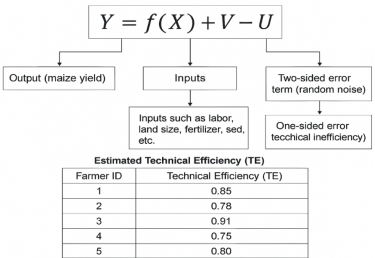
In this subsection, we apply the Cobb-Douglas stochastic frontier production function to estimate the level of technical efficiency (TE) for each respondent. The model used is specified as follows:
ln⁡Y=α+∑βiln⁡Xi+Vi-Ui
Y = Output (maize yield)
Xi= Inputs such as labor, land size, fertilizer, seed, etc.
Vi= Two-sided error term (random noise)
Ui = One-sided error term (technical inefficiency)
The level of technical efficiency for each farmer was assed and the factors that contribute to inefficiency. The estimated the level of technical efficiency (TE) scores for a sample of farmers are shown in Table 3.
Table 3. Estimated The level of technical efficiency (TE) of Farmers.

Farmer ID

The level of technical efficiency (TE)

1

0.85

2

0.78

3

0.91

4

0.75

5

0.80

Source: Field Data, 2025
Figure 2. Cobb-Douglas stochastic frontier production function.
Based on Table 3 and Figure 2, the estimated the level of technical efficiency (TE) scores for the sample of farmers range from 0.75 to 0.91, indicating that while most farmers are relatively efficient, there is still significant room for improvement. On average, the farmers could improve their efficiency by up to 25% by reducing inefficiencies in their input usage. The Stochastic Frontier Analysis suggests that factors such as education, farm size, and access to extension services contribute to inefficiency. These results are consistent with , who found that inefficiencies in smallholder farming are often linked to inadequate resource management and access to modern technology. Additionally, a study supports these findings, showing that farmers with better education and technology access had higher the level of technical efficiency scores. , also argue that inefficiencies could be reduced significantly through better access to education, technology, and extension services, which would help improve overall technical efficiency. However, , caution that without addressing underlying structural issues, such as land fragmentation, inefficiencies may persist even with improved access to resources.
5. Conclusion and Recommendations
This study reveals that the level of technical efficiency in maize production among smallholder farmers in Uasin Gishu and Transzoia counties remains suboptimal, with efficiency scores ranging from 0.75 to 0.91. These findings indicate that farmers could potentially increase maize yields by up to 25% through better resource utilization and management. Key factors such as education, farm size, and access to extension services significantly influence technical efficiency. Persistent challenges like limited access to modern inputs, climate-related stresses, and land fragmentation continue to hinder optimal productivity. Addressing these inefficiencies is critical to closing the yield gap and strengthening food security in these pivotal maize-producing regions.
Based on these findings, targeted interventions are urgently needed to improve technical efficiency in maize production. First, enhancing farmer education and training programs will empower smallholders with better knowledge and skills to optimize input use. Expanding and strengthening agricultural extension services can improve access to modern technologies and advisory support. Policies should also address land fragmentation through land consolidation or cooperative farming to enable efficient resource management. Finally, improving access to affordable quality inputs such as seeds and fertilizers will support sustainable productivity growth and improve rural livelihoods in Uasin Gishu and Transzoia.
Abbreviations

SFA

Stochastic Frontier Analysis

FAO

Food and Agriculture Organization

MALF

Ministry of Agriculture, Livestock and Fisheries

KALRO

Kenya Agricultural and Livestock Research Organization

CIMMYT

International Maize and Wheat Improvement Center

ORCID

Open Researcher and Contributor ID

TE

Technical Efficiency

Conflicts of Interest
The author declares no conflicts of interest.
References
[1] Aigner, D., Lovell, C. A. K., & Schmidt, P. (1977). Formulation and estimation of stochastic frontier production function models. Journal of Econometrics, 6(1), 21–37.
[2] Akinola, A., Alene, A. D., Adeyemo, R., Sanogo, D., & Olanrewaju, A. (2017). Impact of education and extension services on maize production in Nigeria. International Journal of Agricultural Economics and Extension, 5(4), 455–463.
[3] Akudugu, M. A., Guo, E., & Dadzie, S. K. (2013). Adoption of modern agricultural production technologies by farm households in Ghana: What factors influence their decisions? Journal of Biology, Agriculture and Healthcare, 3(5), 2224–3208.
[4] Coelli, T. J., & Battese, G. E. (2006). An Introduction to Efficiency and Productivity Analysis (2nd ed.). Springer.
[5] Coelli, T. J., Rao, D. S. P., O’Donnell, C. J., & Battese, G. E. (2005). An Introduction to Efficiency and Productivity Analysis (2nd ed.). Springer.
[6] Coelli, T., Prasada Rao, D. S., & Battese, G. E. (1998). An introduction to efficiency and productivity analysis. Kluwer Academic Publishers.
[7] County Integrated Development Plan. (2018–2022). Transzoia County Government.
[8] CIMMYT. (2019). Improving maize productivity through sustainable intensification practices. International Maize and Wheat Improvement Center.
[9] Fare, R., Grosskopf, S., & Lovell, C. A. K. (1985). The Measurement of Efficiency of Production. Springer.
[10] FAO. (2019). The State of Food and Agriculture 2019. Food and Agriculture Organization of the United Nations.
[11] FAO. (2020). Kenya Country Programming Framework (2020–2024). Food and Agriculture Organization.
[12] FAO. (2022). FAOSTAT: Crops and livestock products. Food and Agriculture Organization.
[13] Getachew, M., & Bamlak, T. (2014). Technical efficiency of smallholder maize production in Ethiopia: Stochastic frontier approach. African Journal of Agricultural Research, 9(20), 1544–1553.
[14] Jat, M. L., Wani, S. P., Sahrawat, K. L., & Singh, P. (2018). Climate smart technologies for agriculture: Improving productivity, resilience and emissions. International Journal of Agricultural Sustainability, 16(3), 187–205.
[15] Kalro-KCEP. (2016). Baseline Survey Report: Kenya Cereal Enhancement Programme. Kenya Agricultural and Livestock Research Organization.
[16] Kenya Markets Trust. (2020). Post-harvest handling and maize market inefficiencies in Kenya.
[17] Kenya Revenue Authority. (2023). Agricultural input tax review and implications.
[18] Kothari, C. R. (2004). Research Methodology: Methods and Techniques (2nd ed.). New Age International.
[19] Kumbhakar, S. C., Wang, H.-J., & Horncastle, A. P. (2014). A Practitioner's Guide to Stochastic Frontier Analysis Using Stata. Cambridge University Press.
[20] Liu, Y., Zhou, Y., & Li, Y. (2021). Examining the role of education in agricultural efficiency. Journal of Rural Studies, 81, 185–193.
[21] Majiwa, E., & Mugodo, D. (2018). Technical efficiency and technology gaps in rice farming in Kenya: A meta-frontier analysis. African Journal of Agricultural Research, 13(23), 1189–1200.
[22] MALF. (2020). Annual Agriculture Report 2020. Ministry of Agriculture, Livestock and Fisheries.
[23] MALF. (2021). Kenya Agriculture Sector Transformation and Growth Strategy. Ministry of Agriculture.
[24] MALF. (2023). County Maize Production Potential Report. Ministry of Agriculture, Livestock and Fisheries.
[25] Maredia, M. K., Reyes, B., & Paredes, D. (2020). Education and technology adoption in developing countries. World Development, 129, 104907.
[26] Munyua, H., Omondi, D. A., & Musyoka, R. N. (2014). Technical efficiency of maize production in Uganda. Journal of Development and Agricultural Economics, 6(8), 345–352.
[27] Ngeno, V. K., Kimeli, L., & Bett, C. (2014). Analysis of technical efficiency in maize production in Uasin Gishu County. Kenya Journal of Agricultural Economics, 6(2), 45–52.
[28] Ogada, M. J., Mwabu, G., & Muchai, D. (2014). Farm technology adoption in Kenya: A simultaneous estimation of demand and supply. Agricultural Economics, 45(6), 585–596.
[29] Rahi, S. (2017). Research design and methods: A systematic review of research paradigms, sampling issues and instruments development. International Journal of Economics & Management Sciences, 6(2), 1–5.
[30] Saha, B., Chakraborty, P., & Dutta, S. (2022). Farm structure and efficiency: A micro-level study. Agricultural Economics Research Review, 35(1), 15–28.
[31] Schmidt, P. (1976). On the statistical estimation of parametric frontier production functions. Review of Economics and Statistics, 58(2), 238–239.
[32] Seaman, C. E., Thompson, D., & Harris, J. (2022). Choosing and implementing research design in agricultural economics. Journal of Applied Research in Agricultural Economics, 12(3), 101–115.
[33] Shafiq, M., & Rehman, T. (2000). The extent of resource use inefficiencies in cotton production in Pakistan’s Punjab: An application of data envelopment analysis. Agricultural Economics, 22(3), 321–330.
[34] Silva, C., Duarte, R., & Silva, P. (2021). Survey research in agricultural policy: Trends and perspectives. Journal of Rural Studies, 84, 47–55.
[35] World Bank. (2021). Climate Change and Agriculture in Africa: Impacts and Responses.
[36] Zhang, Y., Liu, C., & Xiao, Y. (2021). The impact of farmer education on agricultural efficiency: Evidence from rural China. Sustainability, 13(9), 4657.
Cite This Article
  • APA Style

    Kimais, N. K. (2026). Level of Technical Efficiency in Maize Production in Uasin Gishu and Transzoia Counties in Kenya. International Journal of Agricultural Economics, 11(5), 178-185. https://doi.org/10.11648/j.ijae.20261105.13

    Copy | Download

    ACS Style

    Kimais, N. K. Level of Technical Efficiency in Maize Production in Uasin Gishu and Transzoia Counties in Kenya. Int. J. Agric. Econ. 2026, 11(5), 178-185. doi: 10.11648/j.ijae.20261105.13

    Copy | Download

    AMA Style

    Kimais NK. Level of Technical Efficiency in Maize Production in Uasin Gishu and Transzoia Counties in Kenya. Int J Agric Econ. 2026;11(5):178-185. doi: 10.11648/j.ijae.20261105.13

    Copy | Download

  • @article{10.11648/j.ijae.20261105.13,
      author = {Nickson Kiprotich Kimais},
      title = {Level of Technical Efficiency in Maize Production in Uasin Gishu and Transzoia Counties in Kenya},
      journal = {International Journal of Agricultural Economics},
      volume = {11},
      number = {5},
      pages = {178-185},
      doi = {10.11648/j.ijae.20261105.13},
      url = {https://doi.org/10.11648/j.ijae.20261105.13},
      eprint = {https://article.sciencepublishinggroup.com/pdf/10.11648.j.ijae.20261105.13},
      abstract = {Maize is a vital staple crop in Kenya, essential to both food security and rural livelihoods, especially in key producing regions like Uasin Gishu and Transzoia Counties. Despite their potential, maize yields in these counties remain significantly below optimum levels-averaging 400,000 and 600,000 metric tons respectively, against potentials of 900,000 and 1,000,000 metric tons. This discrepancy signals inefficiencies in resource use among smallholder farmers. To investigate this issue, the study focused on assessing the level of technical efficiency in maize production and identifying the factors contributing to inefficiency. Rooted in the Stochastic Frontier Analysis (SFA) framework and guided by the Cobb-Douglas production function, the study adopted a descriptive survey design. A sample of 274 farmers was selected from a target population of 16,300 using Cochran’s 1963 formula and stratified random sampling. Primary data were collected through structured, self-administered questionnaires. The results revealed that technical efficiency among farmers ranged from 0.75 to 0.91, with significant inefficiency driven by factors such as education level, farm size, and access to extension services. These findings indicate that productivity could be improved by up to 25% through more efficient resource utilization. The study recommends targeted policy interventions, including farmer training, expanded extension services, and improved access to modern inputs to enhance maize productivity and food security in the region.},
     year = {2026}
    }
    

    Copy | Download

  • TY  - JOUR
    T1  - Level of Technical Efficiency in Maize Production in Uasin Gishu and Transzoia Counties in Kenya
    AU  - Nickson Kiprotich Kimais
    Y1  - 2026/10/15
    PY  - 2026
    N1  - https://doi.org/10.11648/j.ijae.20261105.13
    DO  - 10.11648/j.ijae.20261105.13
    T2  - International Journal of Agricultural Economics
    JF  - International Journal of Agricultural Economics
    JO  - International Journal of Agricultural Economics
    SP  - 178
    EP  - 185
    PB  - Science Publishing Group
    SN  - 2575-3843
    UR  - https://doi.org/10.11648/j.ijae.20261105.13
    AB  - Maize is a vital staple crop in Kenya, essential to both food security and rural livelihoods, especially in key producing regions like Uasin Gishu and Transzoia Counties. Despite their potential, maize yields in these counties remain significantly below optimum levels-averaging 400,000 and 600,000 metric tons respectively, against potentials of 900,000 and 1,000,000 metric tons. This discrepancy signals inefficiencies in resource use among smallholder farmers. To investigate this issue, the study focused on assessing the level of technical efficiency in maize production and identifying the factors contributing to inefficiency. Rooted in the Stochastic Frontier Analysis (SFA) framework and guided by the Cobb-Douglas production function, the study adopted a descriptive survey design. A sample of 274 farmers was selected from a target population of 16,300 using Cochran’s 1963 formula and stratified random sampling. Primary data were collected through structured, self-administered questionnaires. The results revealed that technical efficiency among farmers ranged from 0.75 to 0.91, with significant inefficiency driven by factors such as education level, farm size, and access to extension services. These findings indicate that productivity could be improved by up to 25% through more efficient resource utilization. The study recommends targeted policy interventions, including farmer training, expanded extension services, and improved access to modern inputs to enhance maize productivity and food security in the region.
    VL  - 11
    IS  - 5
    ER  - 

    Copy | Download

Author Information
  • Abstract
  • Keywords
  • Document Sections

    1. 1. Introduction
    2. 2. Theoritical Framework
    3. 3. Research Methodology
    4. 4. Data Analysis, Results and Discussion
    5. 5. Conclusion and Recommendations
    Show Full Outline
  • Abbreviations
  • Conflicts of Interest
  • References
  • Cite This Article
  • Author Information